Cloud and object data require additional protection and reliable backup. Tape is the ideal backup and replication medium to store large amounts of data: It is particularly cost-efficient and offers a high level of security thanks to "Air Gap". PoINT Archival Gateway protects your data against loss by technical or human failure or by ransomware. Optional is the combination with PoINT Data Replicator, our solution for automated data replication via S3.

The tape-based object storage PoINT Archival Gateway serves as a target for backup or replication of your cloud and object data. Integrate tape as an additional S3 storage class seamlessly into your storage infrastructure with PoINT Archival Gateway and PoINT Data Replicator. You can access the backup data directly via the S3 interface of the solution. A time-consuming restore process is not necessary.
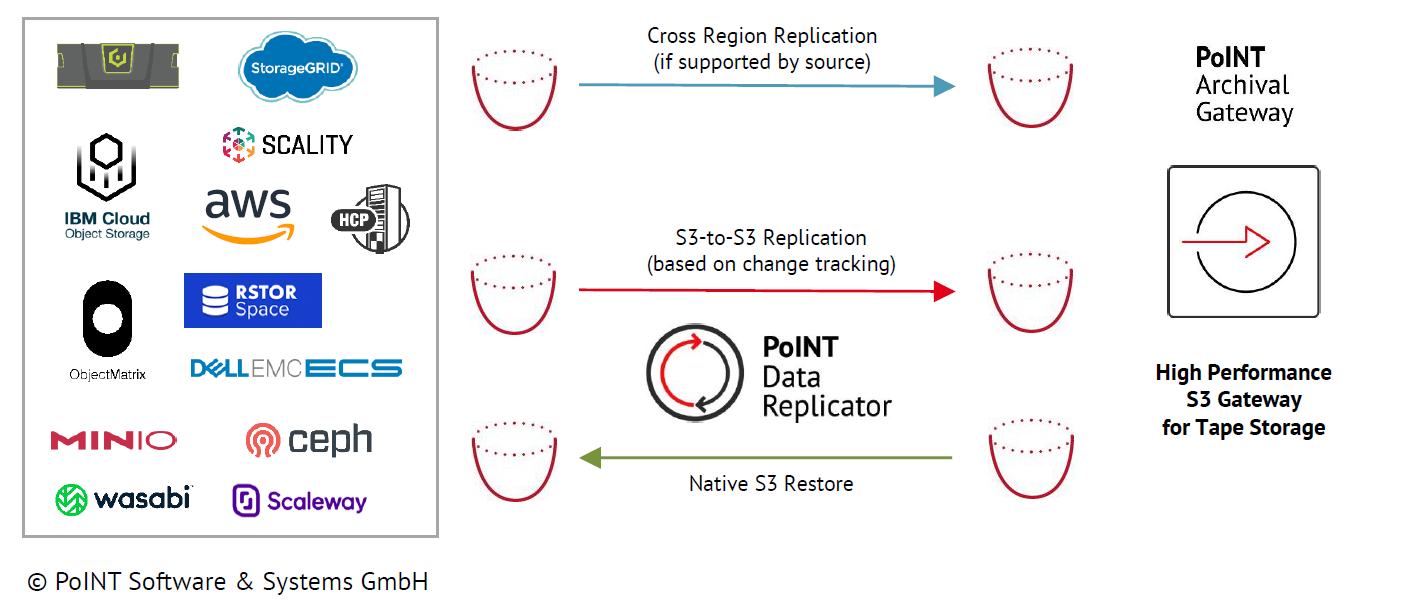
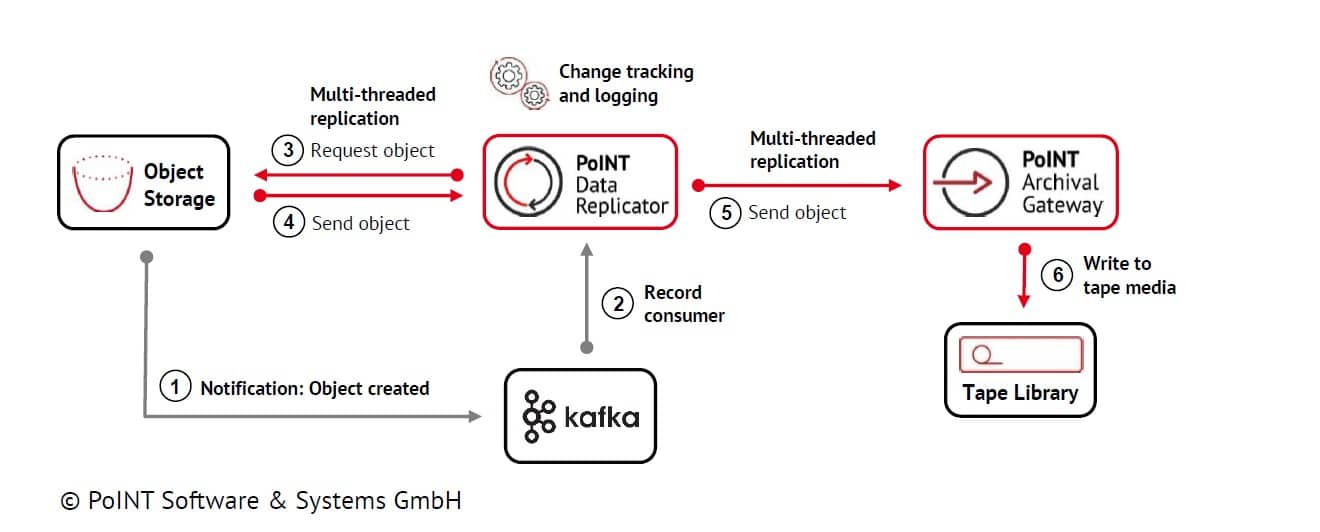
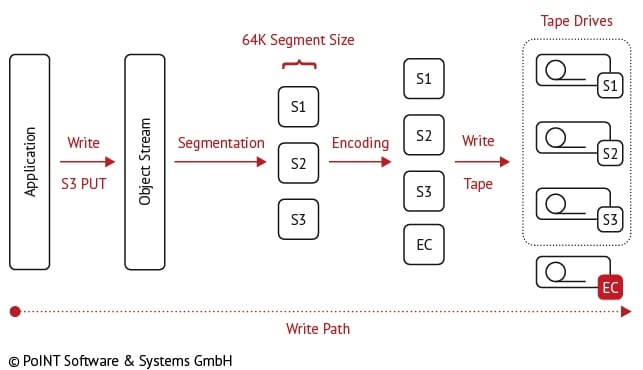
The replication of object data to an offline storage medium creates additional protection. There is no need to restructure the existing storage architecture, and thanks to the standardized interface, workflows are not disrupted. Due to the integrated erasure coding, the data to be backed up is distributed redundantly over several tapes. Thus, even a media error does not lead to a loss of data.
PoINT Archival Gateway and PoINT Data Replicator provide a scalable and powerful solution for backup and storage of data volumes in the order of several hundred petabytes. It is flexibly scalable and uses the standard S3 REST API to replicate and write data from cloud and object storage to tape. The solution also supports Amazon Simple Queue Server (SQS) and the Kafka service. This helps avoid long scan times when changes are made to an S3 bucket that is to be replicated.
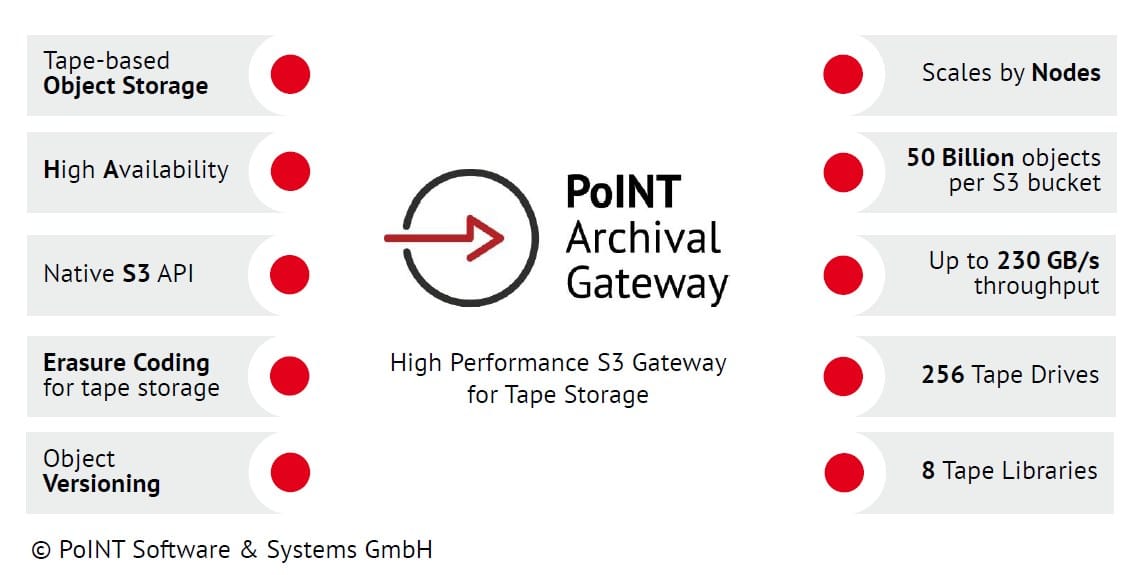
Data is generated faster and faster and in ever larger quantities, e.g. in research, in the media sector or in diagnostics. Our software PoINT Archival Gateway solves the problem of storage and archiving. It stores large amounts of data with high transfer rates directly and securely on tape storage systems.
PoINT Archival Gateway is designed for high parallelism. This applies to the reception of data via the S3 interface as well as to the writing of data to the tape media.
The highly scalable S3 REST web service of PoINT Archival Gateway provides almost unlimited parallelism and very high data transfer rates. PoINT Archival Gateway writes object data directly to the tape media and does not require buffer hard disks. Cumbersome S3 Glacier commands for reading archived data are not necessary.
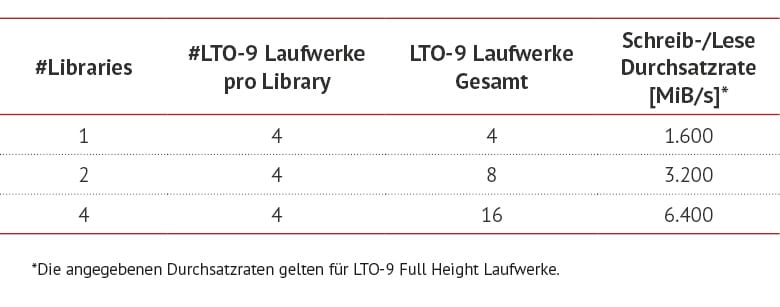
The write process of an Interface Node can write data to up to 8 tape drives in parallel. In the Enterprise Edition of PoINT Archival Gateway up to 24 Interface Nodes can be configured. Thus, up to 192 tape drives can be used in parallel for write and/or read processes. In total PoINT Archival Gateway supports up to 8 tape libraries with up to 24 drives per library.
The following table shows performance examples for different configurations:
Many organizations use disk-based object storage. These on-premises storage systems need to be regularly relieved of obsolete or inactive data. This is where the concept of Information Lifecycle Management comes into play: This storage strategy selects the appropriate storage tier for the data according to its lifecycle. As a rule, obsolete, inactive, "cold" data is no longer accessed. Nevertheless, it must continue to be stored. It is out of place on expensive primary storage systems and is moved to secondary storage using storage tiering and predefined rules.
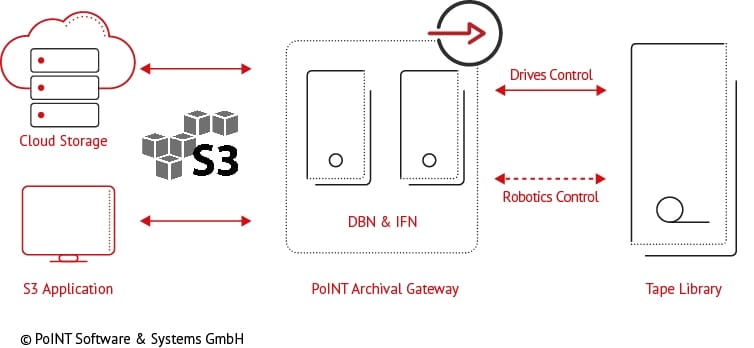
Many disk-based object stores provide integrated ILM functions that can be used move inactive objects. For tiering to tape media, the target system must be an S3-capable storage system that supports tape libraries and that stores the tiered data in the native object format if possible. It is not advisable to first copy the objects to a file system and then store them on tapes. There is a risk of information loss here due to technical limitations. The S3 objects must be stored as such on tape. PoINT Archival Gateway receives the data via the S3 interface and writes it directly to tape media.
PoINT Archival Gateway is a high-performance, scalable object storage that supports tape libraries and that helps to implement a tiered storage architecture for object storage. The software has a standardized S3-REST interface and ensures data protection by the integrated "Erasure Coding". Thus, with the help of PoINT Archival Gateway the large amounts of data from object-based primary storage systems or also from the cloud can be moved or replicated to tape and stored protected in the long term.
Hard disk-based storage systems are predominantly used in the object storage sector. However, as data volumes grow, questions arise about cost-effectiveness and the ecological footprint. In addition, data often has to be archived in the long term.
PoINT Archival Gateway is the answer to this problem: As a software-defined S3 storage it combines a disk storage class with a tape storage class under a single namespace. PoINT Archival Gateway serves as software-defined secondary and archive storage, which selects the optimal storage location for the data based on specified criteria.
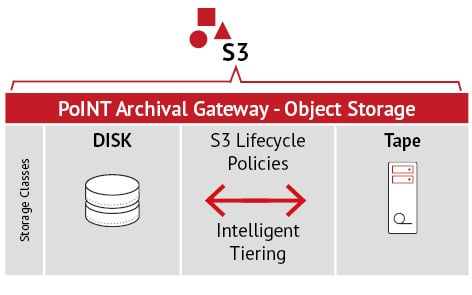
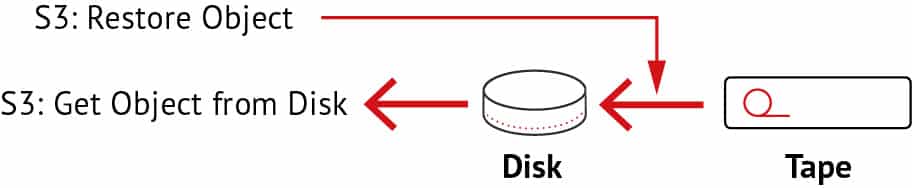
If objects are to be accessed that have already been moved to tape, this access can be performed directly. A time-consuming restore to disk is not necessary.
Optionally, however, such a restore can be executed with the AWS S3-compatible "Restore Object" command via the Glacier API. The objects are temporarily stored on disk. The duration of the storage on disk can be individually defined.
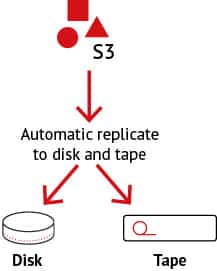
PoINT Archival Gateway provides an optimal backup and replication target for object data. The software receives the data via the S3 interface and replicates it automatically to disk and tape. The integrated Erasure Coding increases data security.
PoINT Archival Gateway is a verified object storage solution and is "Veeam Ready" certified.
For Veeam Backup and Replication, the Veeam SOSAPI is also supported.